Utilizing Artificial Insemination and Embryo Transfers to Improve Genetic Progress
Most commercial cattle come from just what you’d expect… a bull mating with a cow. However, to create the elite level of wagyu beef and genetics we strive for, we use Artificial Insemination (AI) and Embryo Transfers (ET). This allows us to make significant genetic improvement of the herd, while creating the highest quality carcasses, by matching each cow with the exact bull that compliments her traits best..
It would be impossible to own each individual bull to create that best match for each cow. However, with genetic technology and the worldwide Wagyu network, we’re able to buy/sell/ship semen and embryos all over the world.
The process of impregnating a cow with AI or ET is surprisingly simple, in theory. The cows are given a series of three shots over an 8-day period and then inseminated on the 9th day. For ET, the cows undergo the same 8-day process, and the embryo is placed on the 16th day.
To create an embryo, we take the top cows in the herd, and then hand select the ideal bull. “Flushing” is the multi-day process of creating embryos, which are 7 days old when collected. A flush can create anywhere from 0 to over 30 embryos. The purpose of this is to replicate the absolute best cows and matings in the herd. Once the embryos are collected, they are stored in a specialized tank filled with liquid nitrogen, which maintains a temperature of -320⁰F. This preservation process ensures that embryo’s can be kept and used years, and even decades later.
To show the timeline of the whole process, lets start right after the herd has calved for the year, which for our herd is early February. After calving, the cows that are chosen for embryo production are “flushed”, to create the embryos we’ll use for breeding that year.
Those cows, as well as the rest of the herd, are then setup for AI/ET. The Fullblood Wagyu are AI’d and the embryos are transferred into Angus cattle. Angus are used as the “recips” (surrogates) as Angus are less expensive to purchase initially and produce more milk than wagyu. Thus allowing their calves to grow at a faster rate. However, if the embryo doesn’t take and the bull breeds them they’ll still produce fantastic beef (more on that in a minute!). Thirty days after these cows are bred, they’re checked for pregnancies. The industry average for conception with AI/ET is approximatley 60%. We’ve been fortunate in recent years to have above average conception rates, with our highest being 84% in 2024. The cows that are not bred are then moved to a separate pasture where the herd sire is turned in for Natural Service (NS). We’re very fortunate to own a herd sire that is still in the top 10% of the breed! A cows gestation period is 9 months (sounds familiar, right?). So, 9 months later, in a 60-90 day window due to the time between some cows getting bred by AI/ET and others getting bred later by the bull, our calves are born! The Wagyu cows will all have a Fullblood Wagyu calf, but the Angus cows who did not conceive from the ET, will have a calf that’s 50% Angus and 50% Wagyu, also known as an F1. Sixty days later, the process starts all over, which in a perfect world has been exactly 1 year since the beginning of the cycle.
This precise cycle of shots, flushes, and gestation may sound clinical on paper but is a continuous labor of love and science. We take time ensuring that every step of this process is done carefully and meticulously to deliver the unmatched marbling and premium quality that defines true Wagyu. We take pride in pushing the boundaries for what our herd can achieve and look forward to making sure every year is better than the last.
world of wagyu genetics
It All Begins Here
At Brenner Cattle Company, we evaluate cattle based on both phenotype (physical characteristics) and genotype (genetic makeup). While we prioritize raising happy, healthy cows, we recognize that they are also a vital asset and a long-term investment. We love working with them, but we also need them to work for us over the long haul. Good feet, strong bones, and straight backs are prime examples of the physical traits we breed for in our herd. These characteristics are expressed physically but directly correlate to genes that we can pinpoint using genomics. For instance, if a cow has good feet, her calf is highly likely to inherit that structural soundness. If the sire also has good feet, it becomes an even safer bet for the progeny.
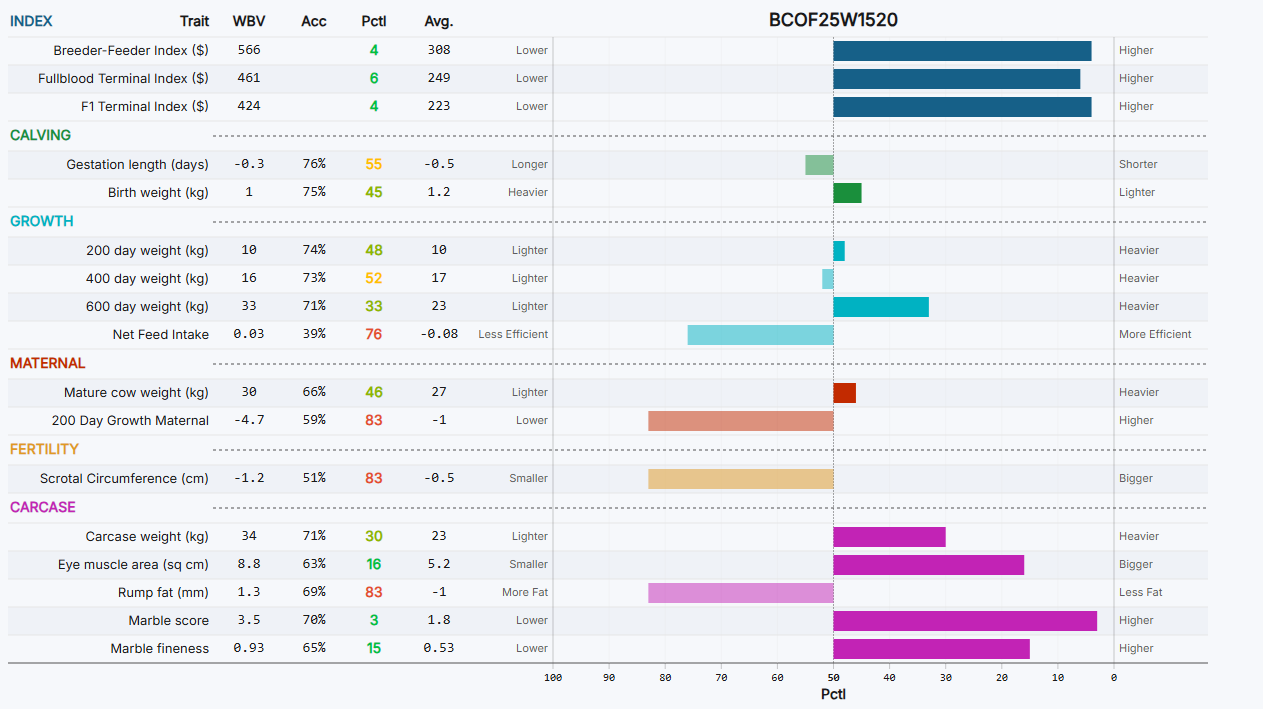
To guide these mating choices, elite breeders rely on data-driven metrics for registered cattle. In Wagyu production, these are known as WBVs, or Wagyu Breeding Values. They measure an individual animal's genetic potential to pass desirable traits onto the next generation. As genomics evolve and our herd data grows, our tools and accuracy only continue to sharpen.
Above is an example of one of the animals WBV’s (in this case a young heifer), shown on a graph. The middle of the graph represents the average for the breed, for that year. For each individual measurable trait, to the right is above average, and to the left is below average, relative to the registered herd for that given year. In the registered cattle world, the average is still pretty darn good. And historically, if an animal has good growth traits, its carcass traits would suffer, and conversely. Using genomically enhanced WBV’s however, we can choose matings that improve the expected genetic merit of each individual trait.
The phenotype and genotype of the cow and the bull matter. In our herd, both are looked at very carefully for every mating decision. This ensures the quality of our cattle, their genetics, and ultimately our beef. If you’re interested in talking more in depth about any of this, please give us a call!
Welcome to Brenner Cattle Company blOGS!
It All Begins Here
We are thrilled to kick off a brand-new weekly series dedicated to bringing you the latest updates from the ranch, exclusive sneak peeks, and deep dives into the world of premium Wagyu. Whether you're a longtime supporter or just joining the Brenner Cattle Co. family, you can expect a fresh mix of educational reads, ranch updates, and intentional insights delivered straight to your inbox every week.
To kick things off, we’re diving straight into what makes our beef truly exceptional. This week, we are looking under the hood at the fascinating world of Wagyu genetics.